
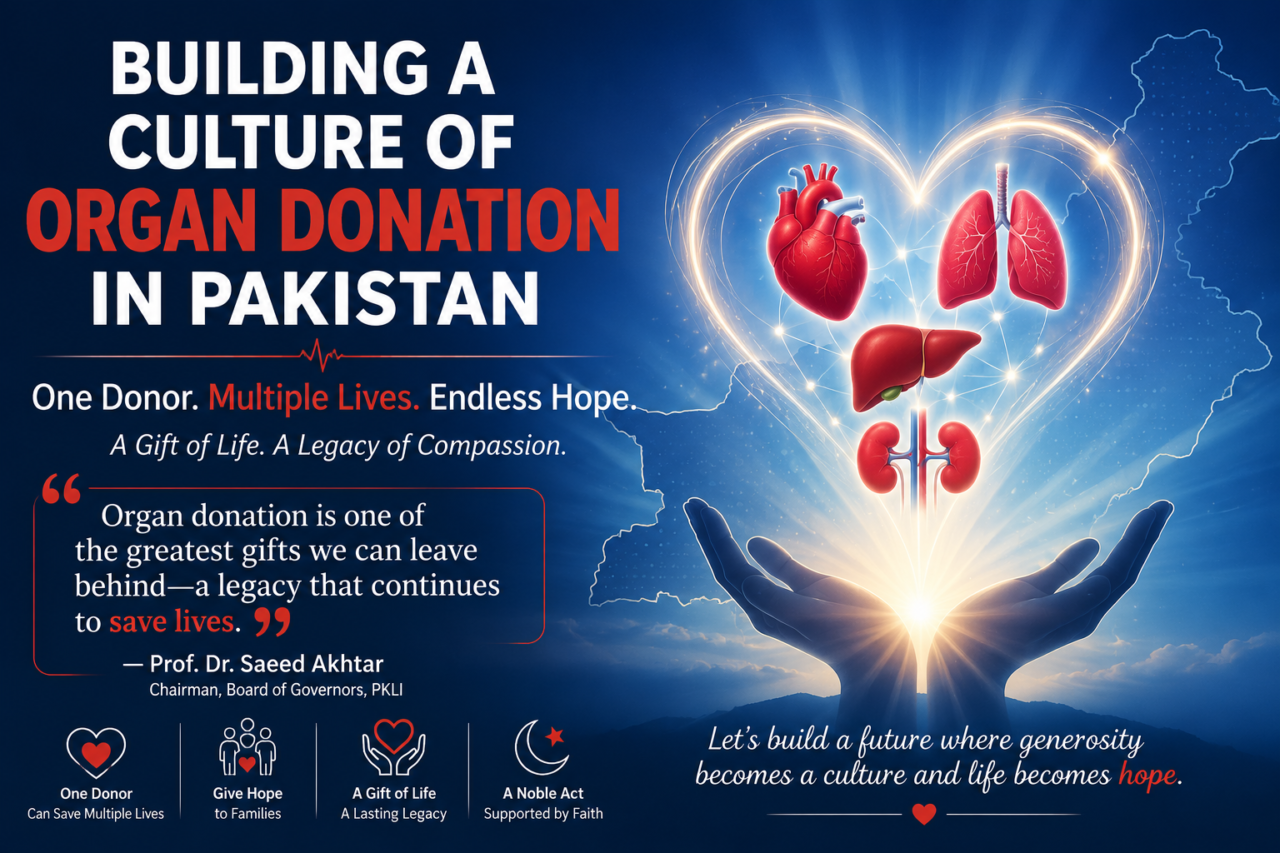
One Donor. Multiple Lives. Endless Hope.
Pakistan has made remarkable progress in transplantation medicine over the past two decades. Through the dedication of healthcare professionals, institutions such as the Pakistan Kidney and Liver Institute (PKLI), and the generosity of organ donors and their families, thousands of patients have received a second chance at life through liver and kidney transplantation.
Yet despite these achievements, many patients continue to face a difficult reality: the shortage of available organs.
As Pakistan looks toward the future of transplantation, building a culture of organ donation has become one of the most important healthcare challenges—and opportunities—of our time.
A Growing Need
Every year, thousands of Pakistanis suffer from end-stage organ failure. While many kidney and liver transplants can be performed through living donors, not every patient has a suitable family donor.
For patients requiring heart, lung, pancreas, and certain emergency transplant procedures, deceased donor transplantation remains essential.
Medical experts continue to emphasize that increasing public awareness and participation in organ donation is critical if Pakistan is to meet the growing need for life-saving transplants.
A Longstanding Vision
For many years, Prof. Dr. Saeed Akhtar has advocated for ethical organ donation and greater public awareness regarding transplantation.
Throughout his career, he has emphasized that transplantation is not simply a medical procedure—it is an opportunity to save lives, support families, and serve humanity.
He has consistently encouraged greater understanding of deceased organ donation and has highlighted the importance of building a system that allows more patients to receive the life-saving treatment they need.
According to Dr. Akhtar, the future of transplantation depends not only on surgical expertise and medical innovation but also on public participation, awareness, and compassion.
Progress Through Ethical Transplantation
Pakistan has already taken important steps toward building an ethical and regulated transplantation system.
The Transplantation of Human Organs and Tissues Act, enacted in 2010, helped prohibit the commercial sale of human organs and established a legal framework for ethical transplantation practices.
This legislation strengthened public trust while reinforcing the principle that organ donation should always be based on generosity, compassion, and service to humanity.
The law also created a foundation for organizations and authorities to regulate transplantation activities and promote responsible organ donation throughout the country.
Living Donation and Deceased Donation
When discussing transplantation, Dr. Akhtar often explains that there are two primary sources of organ donation.
The first is living donation, where a healthy individual donates a kidney or a portion of their liver to help a family member or loved one.
The second is deceased organ donation, also known as donation after death, in which organs from a person who has been declared brain dead may be used to save the lives of others.
While living donor transplantation has helped thousands of patients, many individuals do not have suitable donors available.
For these patients, deceased donor transplantation represents their best hope for survival.
One Donor Can Save Multiple Lives
One of the most powerful messages repeatedly emphasized by Dr. Akhtar is that a single donor can save multiple lives.
Through deceased organ donation, the heart, lungs, kidneys, liver, pancreas, corneas, and other tissues may help patients suffering from life-threatening illnesses.
One act of generosity can impact numerous families and provide hope where few options remain.
Organ donation is not simply a medical intervention—it is a gift of life.
Organ Donation and the Islamic Perspective
One of the most common questions surrounding organ donation relates to faith and religious guidance.
Prof. Dr. Saeed Akhtar has often emphasized that major Islamic scholars and institutions in Pakistan and across the Muslim world have supported ethical organ donation as a means of saving human life.
According to Dr. Akhtar, Islam places great value on preserving life, helping those who are suffering, and serving humanity. He has encouraged individuals and families to learn about the religious perspectives on organ donation and to discuss these matters openly with trusted scholars and healthcare professionals.
He has often reminded audiences that after a person’s passing, organs that would otherwise return to the earth may provide hope and healing to others.
Through ethical organ donation, one individual has the potential to save multiple lives and leave behind a lasting legacy of compassion, generosity, and service.
For many families, organ donation can be viewed as a form of ongoing charity—a gift whose benefits continue long after a person’s lifetime through the lives that are saved and transformed.
The Importance of Family Conversations
Another important message emphasized by Dr. Akhtar is the need for families to discuss organ donation before a crisis occurs.
In moments of unexpected tragedy, families are often faced with difficult decisions while coping with grief and shock.
When individuals have already shared their wishes with loved ones, families are better prepared to make informed decisions that honor those wishes and potentially save lives.
Awareness begins with conversation.
Building a Culture of Donation
Creating a culture of organ donation requires more than hospitals and surgeons.
It requires education.
It requires awareness.
It requires communities, religious leaders, healthcare institutions, media organizations, and families working together to increase understanding and encourage informed decision-making.
Recent initiatives such as PKLI’s Life After Life seminar have helped bring together healthcare professionals, policymakers, religious scholars, donor families, and transplant recipients to discuss how Pakistan can move from awareness to action and expand opportunities for life-saving transplantation.
How You Can Help
Every person has the ability to make a difference.
You can help by:
- Learning more about organ donation and transplantation.
- Discussing your wishes with family members and loved ones.
- Encouraging conversations about donation after death.
- Supporting awareness initiatives in your community.
- Exploring donor registration opportunities through HOTA, PHOTA, NADRA, and other authorized organ donation programs in Pakistan.
Most importantly, remember that one conversation can lead to one decision, and one decision can save multiple lives.
A Future of Hope
Pakistan has already demonstrated tremendous capability in transplantation medicine.
The next chapter is about expanding hope.
It is about ensuring that more patients receive the life-saving transplants they need.
It is about building a culture where organ donation is understood, respected, and embraced as a gift of life.
As Prof. Dr. Saeed Akhtar has long emphasized, saving lives requires more than medical expertise—it requires compassion, awareness, and a collective commitment to helping others.
Every donor matters.
Every family matters.
Every life saved matters.
Together, we can help build a future where more patients receive the second chance they deserve.
