info@discoversouls.org
Subscribe to SMS Updates: (850) 308-3944
Supporting 190,000+ Patients Through Pakistan Kidney Institute (PKI)
Think about the last time you or someone in your family went for an injection.
Maybe you had a fever. Maybe your child was sick. Maybe you were worried about an elderly parent.
The healthcare worker prepared the medicine.
You watched.
And perhaps, just for a second, you wondered:
Was that a new syringe?
But did you ask?
Many of us probably would not.
Not because we do not care about our health.
Sometimes we simply do not want the doctor, nurse, dispenser, or healthcare worker to think we are questioning them.
“What if they feel insulted?”
“What if their attitude changes?”
“They know their job. Who am I to ask?”
Rich or poor. Educated or uneducated. City or village.
That hesitation can happen to anyone.
And perhaps there is another side to this moment.
A healthcare worker who has safely treated hundreds of patients may hear:
“Is this syringe new?”
and think:
“Does this patient believe I would use an old syringe?”
The patient is trying to feel safe.
The healthcare worker feels accused.
Both may misunderstand each other.
Yet both want exactly the same thing:
A safe injection.
Instead of accusing, a patient can simply say:
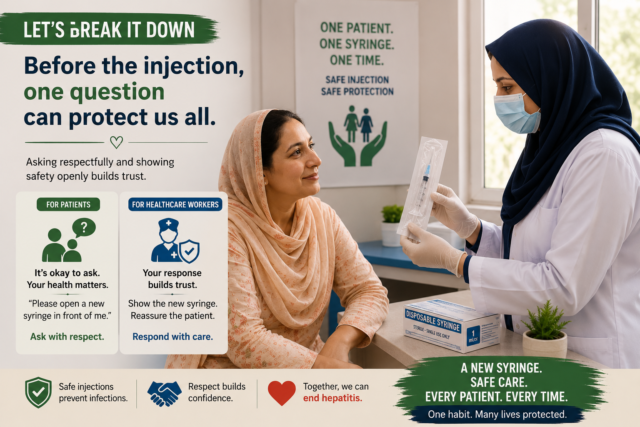
“Please, for my peace of mind, can you open the new syringe in front of me?”
No argument.
No raised voice.
No accusation.
And healthcare professionals can help change this culture too.
Perhaps do not wait for the patient to find the courage to ask.
Open the new syringe where the patient can see it.
A simple sentence—
“This is a new syringe. I am opening it now.”
—may take only seconds.
But it can build trust.
It is easy to point a finger and say, “Someone does not care.”
The evidence from Pakistan tells us the problem is more complicated.
Research has linked syringe reuse with Pakistan’s very high demand for therapeutic injections. Patients may believe an injection works faster or is stronger than oral medicine, and providers may respond to that demand. Studies have also described limited patient awareness of syringe reuse and, in some settings, reuse to reduce costs.
Globally, lack of knowledge and shortages of injection equipment can also contribute to unsafe reuse. But Pakistan-focused research suggests we cannot blame the problem on supply shortages alone. One study comparing injection need with syringe supply found that estimated national supply was sufficient to meet demand.
So perhaps the question is bigger than:
“Who is to blame?”
Maybe we should ask:
“What habit can each side change?”
Patients can stop expecting an injection for every illness and ask whether an injection is medically necessary.
Healthcare professionals can avoid unnecessary injections and make safe injection practice visible.
And when an injection is needed:
A new syringe. Safe care. Every patient. Every time
This is the stigma I want us to break.
A patient asking about a new syringe is not questioning a healthcare worker’s worth or training.
They may simply be learning to participate in their own safety.
And a healthcare worker who openly shows a new syringe is not admitting that healthcare is unsafe.
They are demonstrating good practice and building trust.
Respect can work both ways.
The patient asks respectfully.
The healthcare worker responds with reassurance.
That is not confrontation.
That is patient safety.
Unsafe medical injections remain a serious public-health concern because contaminated injection equipment can transmit bloodborne infections, including hepatitis B and hepatitis C. Pakistan research has repeatedly called for action involving both healthcare providers and people receiving injections.
We cannot treat hepatitis C and continue ignoring preventable routes of new infection.
Testing matters.
Treatment matters.
But prevention must happen before the next infection occurs.
The next time an injection is needed, remember one respectful sentence:
And to every healthcare professional reading this:
No accusation.
No embarrassment.
No difference between a rich patient and a poor patient.
Safe care should look the same for everyone.
Together, patients and healthcare professionals can help move Pakistan closer to one goal: a Hepatitis-Free Pakistan.
WHO EMRO — Reuse of syringes for therapeutic injections in Pakistan
PubMed — Pakistan syringe reuse determinants study
WHO — Infection Prevention and Control Training Handbook
Pakistan’s unsafe medical injections and the enduring public health challenge
Aga Khan University — Comparison of need and supply of syringes in Pakistan