info@discoversouls.org
Subscribe to SMS Updates: (850) 308-3944
Supporting 190,000+ Patients Through Pakistan Kidney Institute (PKI)
Egypt once had one of the highest hepatitis C rates in the world.
Today, it has reached the World Health Organization’s gold-tier status on the path to hepatitis C elimination.
This does not mean every case has disappeared. It means Egypt has made major progress in finding people with hepatitis C, treating them and reducing new infections.
The medicine was important, but medicine alone did not create this change.
The real difference was making sure people could move from testing to treatment without being left behind.
Egypt did not wait for everyone to visit a large hospital.
Through the 100 Million Healthy Lives campaign, screening was offered in communities, workplaces, places of worship, sports clubs and other public spaces. Mobile teams also reached people who might not normally visit a clinic.
More than 60 million people were tested.
This is important because hepatitis C can remain silent for years. Someone may feel healthy and have no reason to ask for a test.
When people do not know they have the infection, they cannot receive treatment.
That is why testing sometimes has to leave the hospital and reach people closer to home.
While discussing Pakistan’s hepatitis C elimination plans during a visit to the United Nations General Assembly, Prof. Dr. Saeed Akhter referred to Egypt’s progress:
“Egypt as a transcontinental nation that is about to file its elimination status with World Health Organization after concerted efforts.”
His wording may be brief, but the phrase “concerted efforts” explains an important part of Egypt’s success.
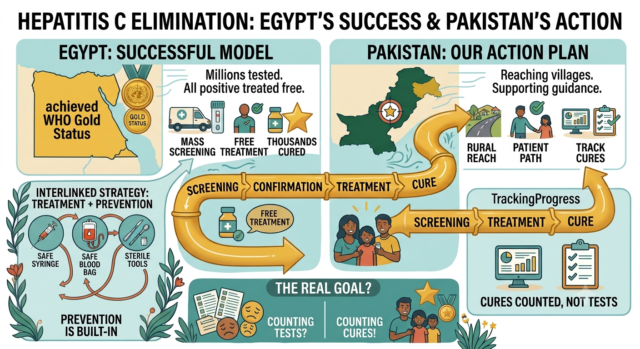
It was not one test, one hospital or one medicine that changed the situation. Egypt brought screening, confirmatory testing, treatment, follow-up, public awareness and prevention together as one organized national effort.
That is also the lesson for Pakistan. Large-scale screening can identify people who may have hepatitis C, but the programme must make sure they are not left behind before confirmation, treatment and cure.
Testing millions of people was a major achievement, but the test itself was only the beginning.
What happened after a screening result was reactive mattered even more.
People who needed further testing were connected with confirmatory testing. Those confirmed to have hepatitis C were offered treatment without charge.
More than 4.1 million people received treatment, and locally produced medicines helped make such a large programme more affordable.
A screening campaign should not leave someone holding a report they do not understand.
The person should know:
Testing finds the infection. A working system helps the person reach treatment and cure.
Egypt used fixed testing centres, mobile teams and digital records to follow the campaign.
The programme could identify areas where fewer people had been screened and send more teams there.
This part may not be visible to the patient, but it is important.
It is not enough to know how many tests were performed. Health programmes also need to know whether people completed confirmatory testing, started treatment and finished it.
Otherwise, someone may be counted during screening but never receive the care they need.
Egypt also worked on injection safety, blood safety and other healthcare practices that can spread hepatitis C.
This matters because a country cannot keep treating people while unsafe practices continue causing new infections.
Treatment and prevention have to move together.
That includes:
Every person cured is progress. But every preventable new infection adds another patient to the system.
Pakistan cannot copy Egypt’s programme exactly. The two countries have different populations, healthcare systems and local challenges.
But some lessons are still useful.
Testing must reach villages and smaller towns, not only people living near major hospitals.
A reactive result must lead to confirmation and treatment.
Families should not have to make repeated long journeys simply to understand a result or receive medicine.
Health authorities should count more than the number of people screened. They should also know how many were confirmed, treated and cured.
Pakistan’s national programme aims to reach more than 164 million people in phases. Reaching that number will require strong systems behind every test.
A large screening number may sound impressive, but it does not tell us how many people actually reached a cure.
The more useful questions are:
How many completed the confirmatory test?
How many began treatment?
How many completed it?
How many were cured?
Egypt’s experience shows that testing works best when every result has a clear next step.
For Pakistan, the goal should not only be to count how many people were tested.
It should be to make sure those who need care are able to complete the full journey.
This article is part of our World Hepatitis Day educational series supporting hepatitis prevention, testing, treatment and elimination in Pakistan.