info@discoversouls.org
Subscribe to SMS Updates: (850) 308-3944
Supporting 190,000+ Patients Through Pakistan Kidney Institute (PKI)
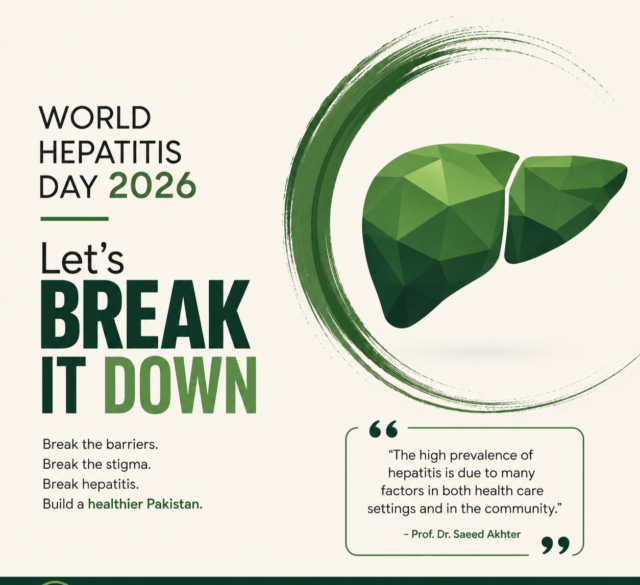
Today, on World Hepatitis Day, SOULS concludes its 28-day hepatitis education series based on the 2026 theme:
“Hepatitis: Let’s Break It Down.”
This series was not created simply to complete a countdown.
It was developed to take one issue at a time and explain it in clear English and with Urdu images on social media so families in Pakistan could better understand how hepatitis spreads, how it can be prevented, why testing should not be delayed and what questions people should feel confident asking during healthcare.
Although the daily posts end today, the complete series will remain on the SOULS website as an educational resource for patients, families and communities.
When the plan for this 28-day campaign was shared with Prof. Dr. Saeed Akhter, he emphasized that serving the cause of hepatitis prevention and elimination is a meaningful service to humanity and to Pakistan.
That message gave a deeper purpose to the series.
For many years, Prof. Dr. Saeed Akhter has emphasized that Pakistan cannot address hepatitis through treatment alone. Prevention must also reach healthcare facilities, blood banks, dental practices, barber shops and the wider community.
In a World Health Organization feature about Pakistan’s hepatitis response, he explained:
“The high prevalence of hepatitis is due to many factors in both health care settings and in the community.”
— Prof. Dr. Saeed Akhter
He identified unsafe syringes, blood that had not been screened before transfusion, unhygienic dental instruments, reused barber blades and inadequate systems for infectious-waste disposal among the practices contributing to hepatitis transmission.
His message helped shape the direction of the SOULS series. It showed why public education must address not only the disease itself, but also the everyday situations in which people may be placed at risk.
Prof. Dr. Saeed Akhter’s work has also demonstrated the importance of connecting prevention, screening and treatment rather than addressing each one separately.
In 2017, WHO documented a collaboration between the Government of Punjab and the Pakistan Kidney and Liver Institute and Research Center. Within the first four months of the partnership, more than 10,000 people had been tested for hepatitis B and C. Patients requiring care were treated without charge or discrimination, and the programme was being expanded across 25 districts of Punjab.
This approach brought together several essential parts of hepatitis elimination:
It also reflected an important principle: people should not have to wait until they are seriously ill before receiving help.
Pakistan now carries the heaviest hepatitis C burden in the world.
Approximately 10 million people in Pakistan are living with hepatitis C, while another 3.8 million are estimated to be living with hepatitis B. Only around 25–30% of those affected know their status, meaning that millions may remain untested and disconnected from treatment.
Hepatitis B and C can remain unnoticed for years. A person may feel healthy while liver damage continues silently. This is why awareness must lead to testing, diagnosis and proper medical care rather than waiting for visible symptoms.
Pakistan has committed to eliminating hepatitis C as a public-health threat by 2030.
On May 14, 2026, Pakistan and WHO launched the Prime Minister’s National Programme for the Elimination of Hepatitis C in the Islamabad Capital Territory. Its initial goal is to reach 1.6 million people in the area, followed by later phases intended to reach more than 164 million people across the country.
This is a major national step, but no government programme can succeed through treatment alone.
Families also need reliable information. Patients need to understand why testing matters, what safe healthcare should look like and where to go after receiving a positive result.
The 2026 World Hepatitis Day theme calls for removing the barriers that stand between people and lifesaving prevention, testing, treatment and care. WHO identifies stigma, limited awareness, health-system gaps and inequality among the reasons millions of people remain undiagnosed or untreated.
For 28 days, the SOULS series broke down these barriers one topic at a time.
The articles explained why every injection should be given with a new syringe, why donated blood must be properly screened and why medical and dental instruments must be sterilized.
The series also discussed the risks of reused barber blades, the importance of hepatitis B vaccination and the need to protect newborn babies promptly after birth.
Families were encouraged to understand that feeling healthy does not always mean a person is free from hepatitis. Other articles explained hepatitis testing, the difference between a hepatitis C antibody result and the PCR test used to confirm an active infection, treatment completion, the possibility of reinfection after cure and the need for continued liver care when serious damage is already present.
Each article focused on one practical question and included reliable references. The goal was not to overwhelm readers with medical terminology, but to help ordinary families understand what they could do next.
Modern medicines can cure most people living with hepatitis C. However, treating existing infections while unsafe practices continue will not end transmission.
This is why Prof. Dr. Saeed Akhter’s message remains so important.
Hepatitis exists both within healthcare settings and within the community. The response must therefore reach both.
Patients should feel comfortable asking:
These are not disrespectful questions. They are reasonable health questions that can help protect patients and families.
Not every barrier is medical.
Some people living with hepatitis remain silent because they fear being blamed, avoided or treated differently. Families may incorrectly believe that hepatitis spreads through sitting together, ordinary social contact or sharing food.
These misunderstandings can cause patients to hide their diagnosis, delay testing or avoid treatment.
Breaking down stigma means replacing fear with facts.
A person living with hepatitis needs privacy, accurate medical guidance, treatment and support. No patient should be made to feel ashamed because of a health condition.
This is especially important for people already carrying the burden of another serious illness. Patients receiving long-term treatment, including dialysis, may already be dealing with physical weakness, repeated procedures, financial pressure and stress within their families. Hepatitis should not become another reason for them to experience judgment or isolation.
WHO’s 2026 campaign specifically calls on communities to combat stigma and discrimination, share accurate information and support the voices of people affected by viral hepatitis.
The purpose of this campaign was never to publish 28 social-media posts and then move on after July 28.
The articles will remain together on the SOULS website so that patients, families, students, community educators and healthcare advocates can return to them when they need practical information.
The hope is that this resource helps:
Prof. Dr. Saeed Akhter’s years of work and his message remind us that hepatitis elimination requires leadership, strong health systems and accessible treatment. It also requires informed communities that understand prevention and feel confident seeking care.
SOULS remains committed to carrying this message forward through public education and access to reliable information.
Pakistan’s goal of eliminating hepatitis C as a public-health threat by 2030 is ambitious, but the tools already exist. Vaccination can prevent hepatitis B, accurate tests can identify infections and modern treatment can cure hepatitis C. What is now required is wider access, safer practices, sustained leadership and public participation.
The 28-day countdown has ended, but the responsibility to break down the barriers to prevention, testing, treatment and care continues.
This article concludes the SOULS 28-day World Hepatitis Day 2026 educational series. The complete series will remain available as a public learning resource.