info@discoversouls.org
Subscribe to SMS Updates: (850) 308-3944
Supporting 190,000+ Patients Through Pakistan Kidney Institute (PKI)
A woman completes her hepatitis C treatment and returns for her follow-up test.
The result says:
Her doctor confirms that she is cured.
She feels relieved and puts all her reports away. The medicine is finished, the virus is gone, and she believes there is no reason to think about her liver anymore.
A few months later, someone asks whether she is still going for liver checkups.
She replies:
Her question makes sense. But before treatment, her doctor had told her that she already had serious liver scarring.
The medicine removed the virus. It did not necessarily remove all the damage that had developed over the years.
Hepatitis C treatment can clear the virus from the body. After cure, the virus is no longer continuing to injure the liver, and the liver may improve over time.
But serious scarring may not completely disappear.
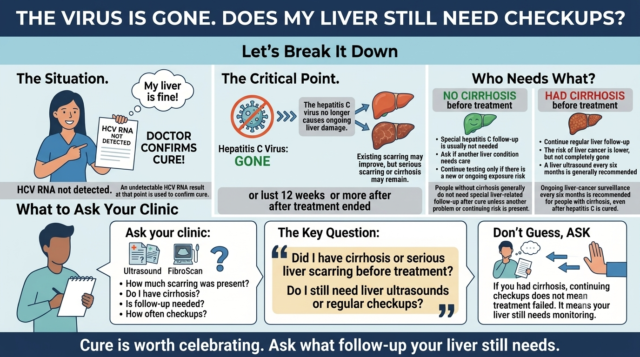
This is especially important for people who had cirrhosis, which means severe liver scarring, before treatment.
A person can feel completely healthy and still need follow-up. Liver scarring often does not cause clear symptoms until the condition becomes more serious.
This does not mean that every person cured of hepatitis C needs lifelong liver appointments.
Someone who did not have cirrhosis may not need special hepatitis C follow-up after cure unless there is another liver condition or a new risk of infection.
The situation is different for someone who already had cirrhosis.
Treatment greatly lowers the risk of serious liver problems, but it does not always remove that risk completely. People with cirrhosis are generally advised to continue regular liver monitoring, often including an ultrasound every six months to watch for liver cancer.
The most useful question is:
Some people remember having blood tests, an ultrasound or a FibroScan, but they may not remember what the results showed.
During diagnosis and treatment, there is already so much information to understand. Words such as fibrosis, scarring and cirrhosis may all begin to sound the same.
Once the PCR result confirms cure, the patient may assume everything is now normal.
That is why the doctor or clinic should clearly explain:
Patients should not have to guess.
Two people may both be cured of hepatitis C but receive different follow-up advice because their livers were not in the same condition before treatment.
One person may be told that no special liver follow-up is needed.
Another may need regular ultrasounds and appointments because cirrhosis was already present.
Continuing checkups does not mean the hepatitis C treatment failed. It means the liver may still need care after living with the infection for many years.
When your cure is confirmed, ask:
And:
The woman was right to celebrate her cure.
Her treatment worked, and hepatitis C was no longer detected in her blood.
But because she had cirrhosis before treatment, her liver still needed regular monitoring.
She took her reports out of the drawer, called the clinic and asked when her next ultrasound should be scheduled.
She was not returning because the virus had come back.
She was returning because being cured did not mean she should stop caring for her liver.
This article is part of our World Hepatitis Day educational series supporting clear information, treatment and proper follow-up for people affected by hepatitis in Pakistan.