info@discoversouls.org
Subscribe to SMS Updates: (850) 308-3944
Supporting 190,000+ Patients Through Pakistan Kidney Institute (PKI)
A man is prescribed a 12-week course of hepatitis C tablets.
For the first few weeks, he takes every dose on time.
He sets an alarm on his phone.
He keeps the medicine where he can see it.
He does not miss a single tablet.
By the fourth week, he begins to feel better.
The tiredness that had followed him for months starts to lift. He has more energy and feels almost like himself again.
Then he looks at the medicine still left in the box and thinks:
He does not like taking medicine unnecessarily.
He worries that continuing the tablets may put more “chemicals” into his body.
So he quietly stops.
He believes the treatment has already done its job.
But feeling better and being cured are not always the same thing.
Modern hepatitis C medicines are called direct-acting antivirals, or DAAs.
They are highly effective. Most people can now be cured with tablets taken for about 8–12 weeks, depending on the medicine and the patient’s individual treatment plan.
Some people may begin feeling better during treatment.
Others may not notice any clear difference at all.
Neither feeling better nor feeling the same can tell us whether the virus has completely disappeared.
Hepatitis C is often silent.
You cannot feel how much virus remains in your blood.
You also cannot feel the exact moment the infection is cured.
That answer comes from completing treatment and having the correct follow-up blood test.
Imagine that a house is on fire.
The fire brigade arrives and quickly brings down the large flames.
The smoke begins to clear.
The heat drops.
From outside, the house may look safe again.
But the firefighters do not immediately pack their equipment and leave.
They continue checking the walls and hidden areas because the work may not yet be finished.
Feeling better during hepatitis C treatment can be like seeing the smoke clear.
It may be a good sign.
But it is not proof that the entire job is complete.
The treatment course is prescribed for a reason. Stopping too early may reduce the chance of achieving a cure.
Hepatitis C tablets should be taken exactly as directed by the treating healthcare professional.
Do not stop because:
The correct treatment length is not the same for everyone.
One patient may receive eight weeks of medicine.
Another may receive twelve weeks.
Some people may need a different plan because of their liver health, previous treatment or other medical factors.
The important point is simple:
Missing a dose does not mean you should panic.
It also does not mean you should double the next dose, restart the treatment yourself or use someone else’s tablets.
Guidance after missed doses depends on how many doses were missed and how long treatment was interrupted. The safest step is to contact the treating clinic and explain honestly what happened.
Do not hide it because you feel embarrassed.
The healthcare team needs accurate information to guide you properly.
You can ask:
Swallowing the last tablet is an important moment.
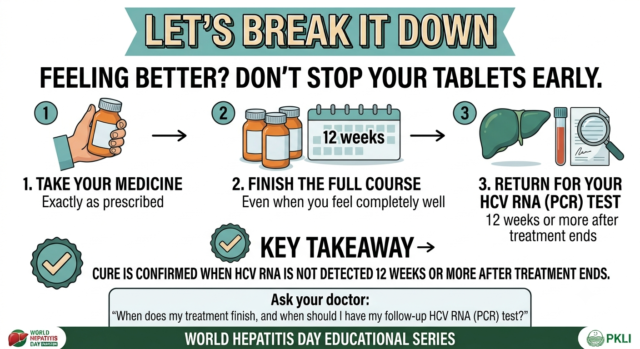
But it is not how cure is officially confirmed.
A patient should have an HCV RNA test, also commonly called a PCR test, 12 weeks or longer after completing treatment.
If the virus is not detected at that time, the patient has achieved what healthcare professionals call a sustained virologic response. This is considered a cure of the hepatitis C infection.
So there are two important dates to remember:
and
Without the follow-up test, a patient may assume the treatment worked without receiving proper confirmation.
Family support can make completing treatment easier.
A family member can help the patient:
The goal is not to watch or criticize the patient.
It is to help them complete a short but very important journey.
If the patient begins feeling better, the family can gently remind them:
Today’s hepatitis C medicines can cure more than 95% of people who receive treatment.
That is real reason for hope.
But treatment should still be taken as prescribed, and cure should still be confirmed after it is completed.
A patient should not stop early because they feel healthy.
They should not change the treatment based on advice from friends, relatives, a pharmacy or social media.
And they should not disappear from care after swallowing the last tablet.
Ask the healthcare professional:
Feeling better is encouraging.
Completing the prescribed course gives the treatment its best chance to work.
And the follow-up PCR test tells you whether the virus is truly gone.
This article is part of our World Hepatitis Day educational series supporting clear information, complete treatment and connection to proper hepatitis care in Pakistan.