info@discoversouls.org
Subscribe to SMS Updates: (850) 308-3944
Supporting 190,000+ Patients Through Pakistan Kidney Institute (PKI)
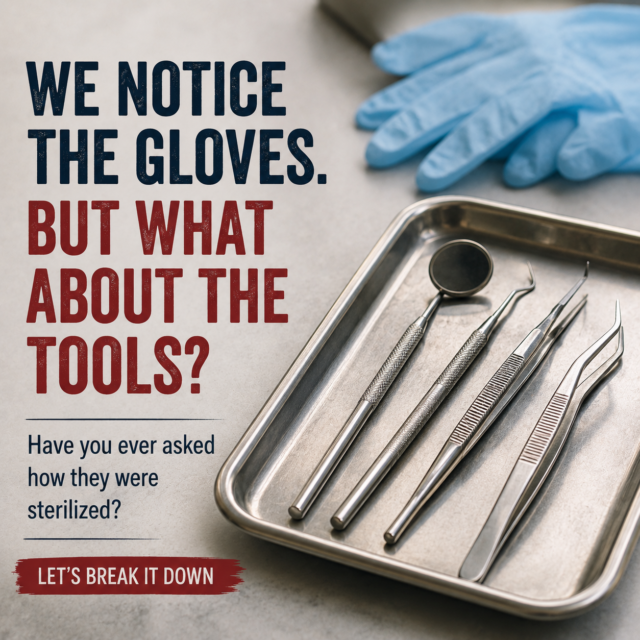
Most of us notice the gloves.
The dentist puts on a fresh pair, and somehow that feels reassuring.
But there is something many of us may never think to ask:
The mirror.
The scaler.
The forceps.
The dental handpiece.
We ask how much a procedure will cost.
We ask whether it will hurt.
We ask how long it will take.
But how often do we ask:
Perhaps many of us have never asked.
And that is exactly why this conversation matters.
A dental clinic may look spotless.
The dental team may wear gloves and masks. The chair may be clean. The instruments may look perfectly polished.
But infection prevention includes much more than what a patient can see.
Reusable dental instruments can become contaminated during patient care. Proper reprocessing is a series of steps that must be carried out correctly before an instrument is safely reused.
Most patients will never see that process.
But patients should still feel comfortable asking about it.
We comfortably ask:
How much will it cost?
Will it hurt?
How long will the procedure take?
Yet asking, “How are your instruments sterilized?” can somehow feel disrespectful.
Perhaps the patient worries the dentist will think:
“You don’t trust me.”
But the patient may simply be saying:
“I want to understand how I am being protected.”
This is the same cultural hesitation we have been discussing throughout this series.
A safety question does not have to become an accusation.
A patient can ask respectfully.
A dental professional can explain confidently.
Safe practice should be something we are comfortable talking about.
In a WHO feature discussing Pakistan’s hepatitis burden, Prof. Dr. Saeed Akhtar described risks found in both healthcare settings and the wider community.
Among the factors he identified were unsafe syringes, failure to screen blood before transfusion, reused razor blades, and unhygienic dental instruments.
That dental point deserves attention.
Almost all of us will sit in a dental chair at some point.
Unlike a disposable syringe or single-use razor blade, many dental instruments are designed to be reused.
So the question is not always:
“Is this new?”
A better question may be:
This is an important difference.
Dental instruments are handled according to how they are used and the infection risk involved.
Under CDC guidance, instruments that penetrate soft tissue or bone are classified as critical items and should be heat sterilized after each use. Many reusable instruments that contact the mouth also require heat sterilization when designed to tolerate heat.
Dental handpieces and certain related attachments should also be cleaned and heat sterilized between patients.
So simply saying:
“The instruments were cleaned.”
may not fully explain the process.
Patients do not need to become infection-control experts.
But proper infection-prevention systems matter.
Dental care is important.
Untreated dental disease can lead to pain, infection and other complications.
This conversation is not telling people to avoid dental care or suggesting that every dental clinic in Pakistan is unsafe.
The point is prevention.
When infection-control practices fail, contaminated equipment can create opportunities for bloodborne infections to spread.
That is why proper instrument processing matters.
The goal is safer care—not fear and not blame.
There is another side to this conversation.
Dentists, dental assistants and other dental staff may also be exposed to blood and sharp instruments during their work.
Infection-prevention systems protect both the patient and the healthcare team.
Hepatitis B vaccination is also recommended for healthcare personnel at risk of occupational blood exposure.
Safe systems protect everyone in the room.
The next time we sit in a dental chair, we may still notice the gloves.
But perhaps we should remember the tools too.
And feel comfortable asking:
Not because we have already decided the clinic is unsafe.
Not because we know more than the dental professional.
Simply because informed patients can ask better safety questions.
Maybe that is what awareness is supposed to do.
We learn something.
We notice something we did not notice before.
And next time, we ask a better question.
Have you ever asked your dentist about instrument sterilization?
This article is part of our World Hepatitis Day educational series supporting hepatitis awareness and prevention in Pakistan.