info@discoversouls.org
Subscribe to SMS Updates: (850) 308-3944
Supporting 190,000+ Patients Through Pakistan Kidney Institute (PKI)
A patient needs blood urgently.
The doctor tells the family:
Within minutes, everyone starts making calls.
A brother contacts relatives.
A cousin messages friends.
Someone posts the blood group in a WhatsApp group.
Another person begins calling blood banks.
The family is already frightened. They are not thinking about systems, testing or paperwork.
They are thinking about one thing:
Then someone finally says:
“I found a donor.”
For a moment, everyone feels relief.
The blood has been arranged.
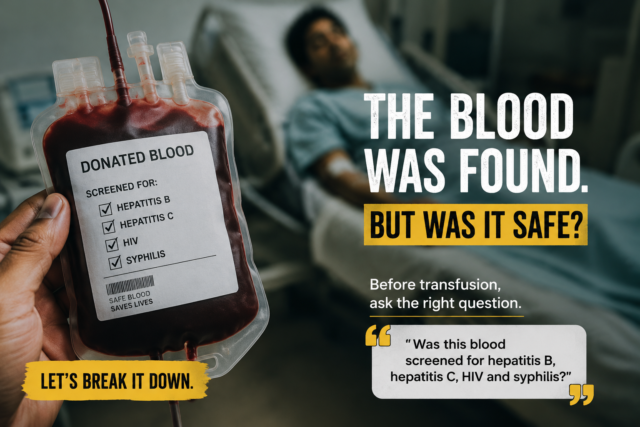
But in that stressful moment, there is one question the family may never think to ask:
Most families assume that if a blood bag is brought into a hospital, all the necessary safety checks have already been completed.
And that is how the system should work.
The patient should not have to investigate every laboratory step while lying sick in a hospital bed.
The family should not have to become blood-safety experts during an emergency.
But awareness still matters because hepatitis B and hepatitis C can spread through infected blood.
A person may look healthy.
They may feel completely fine.
They may honestly believe they have no infection.
But hepatitis can remain unnoticed for years.
That is why donated blood cannot be considered safe simply because the donor looks healthy or is someone the family knows.
It must be tested.
Imagine that the donor is the patient’s brother.
The family knows him well.
They trust him completely.
He does not drink, smoke or appear unwell.
It may feel uncomfortable to even think that his blood could carry an infection.
But screening is not a judgment about the donor.
It is not questioning someone’s lifestyle, character or intentions.
A person can carry hepatitis B or C without knowing it.
Testing protects the patient receiving the blood.
It can also alert the donor to a health condition that might otherwise remain hidden.
Every unit of donated blood should go through the same safety process, whether it comes from a relative, a close friend or a voluntary donor.
When we see a sealed blood bag, it looks official.
There is a label.
There is a blood group.
There may be dates, numbers and signatures.
To a worried family, that may feel like enough.
But the patient’s safety depends on what happened before that bag reached the bedside.
Was the donor assessed properly?
Was the blood collected safely?
Were the sample and blood bag labelled correctly?
Was the donation screened for hepatitis B, hepatitis C, HIV and syphilis?
Were the results reviewed before the blood was released?
Was it stored and transported properly?
Was it matched correctly with the patient?
The family may never see these steps.
But each one matters.
While discussing Pakistan’s hepatitis burden in a World Health Organization feature, Prof. Dr. Saeed Akhter identified several preventable risks.
One of them was:
It is a short statement, but the consequences can last a lifetime.
A patient may enter a hospital because of an accident, surgery, childbirth, severe anaemia or another medical condition.
They may receive blood to save their life.
That lifesaving treatment should never become the reason they leave with a blood-borne infection.
This is why blood screening must never be treated as a formality.
It is part of the treatment itself.
In an emergency, asking questions may feel difficult.
The family may worry that the medical staff will think they are interfering.
They may be afraid of causing a delay.
They may feel grateful that blood was found and hesitate to say anything more.
But a calm safety question is not an accusation.
A family member can simply ask:
They can also ask whether the blood came from a licensed and reliable blood bank.
The purpose is not to challenge the doctor, nurse or laboratory professional.
It is to understand how the patient is being protected.
A safe system should be able to answer that question clearly.
People who donate blood are helping save lives.
Some leave their homes late at night.
Some travel long distances.
Some donate for someone they have never even met.
That generosity deserves respect.
The message is not to fear donors.
The message is that every donation needs proper screening, no matter how kind, healthy or trustworthy the donor appears.
Screening protects the patient.
It protects the donor.
It protects the entire blood supply.
When someone we love needs blood, we will still make the calls.
We will still search for the correct blood group.
We will still feel relief when someone agrees to donate.
But perhaps awareness can help us remember one more step.
Not only:
But also:
Because in that difficult moment, the family is not only trying to find blood.
They are trying to bring their loved one home safely.
The blood was found. Did anyone confirm that it was safe?
This article is part of our World Hepatitis Day educational series supporting hepatitis awareness and prevention in Pakistan.