info@discoversouls.org
Subscribe to SMS Updates: (850) 308-3944
Supporting 190,000+ Patients Through Pakistan Kidney Institute (PKI)
It was such a small cut that you probably forgot about it before you even reached home.
Maybe the barber’s blade caught your skin for a second.
Maybe the skin around your nail bled during a manicure or pedicure.
Someone wiped it.
The service continued.
And no one thought much about it.
We often decide a place is safe by looking around.
A clean floor.
A fresh towel.
A beautiful salon.
A barber we have known for years.
And naturally, we trust the person providing the service.
But blood safety cannot be judged only by how clean a place looks.
Hepatitis B and C can spread through infected blood. With hepatitis C, the amount of blood involved may be too small to see.
So perhaps we need to start paying attention to something we often overlook:
The tool.
Trust matters.
Many people have known their barber for years. Families may visit the same salon again and again.
So asking about a blade or tool can feel uncomfortable.
“Bhai, naya blade mere samne laga dein.”
(Brother, please put in a new blade in front of me.)
It is a simple request.
But some customers may still think:
Will he feel I don’t trust him?
Will I embarrass him?
Why should I ask when everyone else is sitting quietly?
This is similar to what we discussed about syringes.
The customer is thinking about safety.
The person providing the service may hear the question as an accusation.
And somewhere between trust and hesitation, no one talks about the actual risk.
Maybe this is another stigma we need to break.
Pakistan has studied hepatitis awareness and practices among barbers for years.
Research has found gaps in knowledge about hepatitis B and C transmission and safe razor practices. Educational programmes involving barbers have also shown that awareness can improve.
This tells me something important.
Education matters for both sides.
A customer should feel comfortable asking to see a new blade.
And a barber should not have to feel insulted by the question.
In fact, why wait for the customer to ask?
Open the new blade where the customer can see it.
Make safe practice visible.
That small action may actually build more trust.
A customer may think:
“This barber takes my safety seriously.”
Safe practice should be something a business is proud to show.
For a moment, think about a manicure or pedicure.
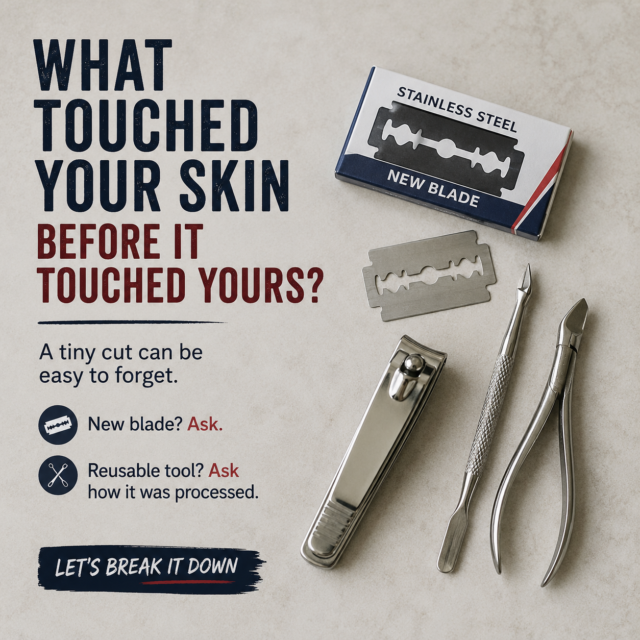
Nail clippers.
Cuticle cutters.
Scissors.
Other sharp reusable tools.
Sometimes the skin is accidentally cut.
Maybe there is a tiny spot of blood.
It is wiped away, and the service continues.
Again, the question is not whether the salon looks clean.
The question is:
A study involving women working in beauty salons in Karachi found important gaps in awareness and preventive practices related to hepatitis B and C. The researchers called for greater education and safer practices among salon workers.
This should not become a campaign against salon workers.
The question is different:
A person may be excellent at their work.
They may have years of experience.
But if no one has properly taught them about bloodborne infections and correct instrument processing, how do we expect every safety practice to automatically be understood?
Instead of only blaming, we need to educate.
Imagine if this question became normal:
“Please batayein, yeh tools har customer ke baad kaise saaf aur process kiye jate hain?”
(Please tell me how these tools are cleaned and processed after each customer.)
Not shouted.
Not asked as an accusation.
Just a normal safety question.
And imagine if the salon worker confidently explained their process.
That is the culture I hope we can create.
A customer who feels comfortable asking.
A service provider who feels proud to show safe practice.
Safety and respect do not have to work against each other.
We also need to be accurate.
Not every tool needs to be thrown away after one customer.
A blade intended for single use should be new and should not be reused.
Reusable instruments are different. They need the correct cleaning and processing between clients based on the type of instrument and the level of blood-exposure risk.
Simply wiping a tool or judging it by appearance is not the same as knowing it has been appropriately processed.
For customers, the message is simple:
You do not need to become an infection-control expert to ask a basic safety question.
In a WHO feature on Pakistan’s hepatitis burden, Prof. Dr. Saeed Akhtar specifically identified the reuse of razor blades by barbers, along with unsafe syringes, unscreened blood, and unhygienic dental instruments, among factors contributing to hepatitis transmission in Pakistan.
That is why awareness cannot stop inside hospitals and clinics.
Hepatitis prevention also belongs in the everyday places where a sharp tool may come into contact with blood.
Barber shops.
Beauty salons.
And any setting where instruments may accidentally break the skin.
Pakistan’s National Hepatitis Strategic Framework 2024–2030 places prevention and improved access to care among the country’s key strategic objectives.
Treatment matters.
Testing matters.
But prevention asks us to look at the infection before it happens.
The cut may heal quickly.
You may forget it by tomorrow.
The bigger question is whether the tool that caused it was safe for you.
So the next time you sit in a barber’s chair, ask respectfully:
“Bhai, naya blade mere samne laga dein.”
(Brother, please put in a new blade in front of me.)
At a salon, ask:
“Yeh tools har customer ke baad kaise process kiye jate hain?”
(How are these tools processed after each customer?)
And if you are a barber or salon professional reading this:
Do not wait for the customer to become afraid enough to ask.
Show your safe practice.
Explain it.
Be proud of it.
Ask. Show. Protect.
One more everyday habit we can change as we work toward one goal: a Hepatitis-Free Pakistan.
This article is part of our World Hepatitis Day educational series supporting hepatitis awareness and prevention in Pakistan.