info@discoversouls.org
Subscribe to SMS Updates: (850) 308-3944
Supporting 190,000+ Patients Through Pakistan Kidney Institute (PKI)
“Doctor sahib, koi injection laga dein. Jaldi araam aa jaye ga.”
(Doctor, please give me an injection. I will feel better quickly.)
How many times have we heard this in Pakistan?
Perhaps we have said it ourselves.
A tablet was taken earlier. A few hours have passed, but the pain is still there. The fever has not completely settled. A baby is still crying. Someone in the family becomes worried and says:
“Injection lagwa lo. Jaldi asar kare ga.”
(Get an injection. It will work quickly.)
In many homes, an injection is seen as stronger, faster, and more serious than medicine taken by mouth. A visit may even feel incomplete if the doctor does not prescribe one.
But this familiar belief can create a preventable health risk.
Research from Pakistan has described a common belief that injections provide quicker relief or work better than medicines taken by mouth.
Patient expectations can also influence treatment practices.
A patient may leave a clinic thinking:
“Doctor ne injection bhi nahi lagaya.”
(The doctor did not even give me an injection.)
The healthcare professional may know that oral medicine is appropriate, but may also feel pressure to satisfy the patient’s expectations.
Neither side may intend harm.
The patient wants relief.
The healthcare professional wants the patient to feel cared for.
But together, we may continue a habit that deserves to be questioned.
When pain, fever, or another symptom does not improve within a few hours, it does not automatically mean that oral medicine has failed or that an injection is now necessary.
Different illnesses recover at different rates. Medicines also vary in how quickly they act and whether they are appropriate for a particular condition.
The decision should be based on a proper medical assessment—not on the assumption that an injection must be stronger.
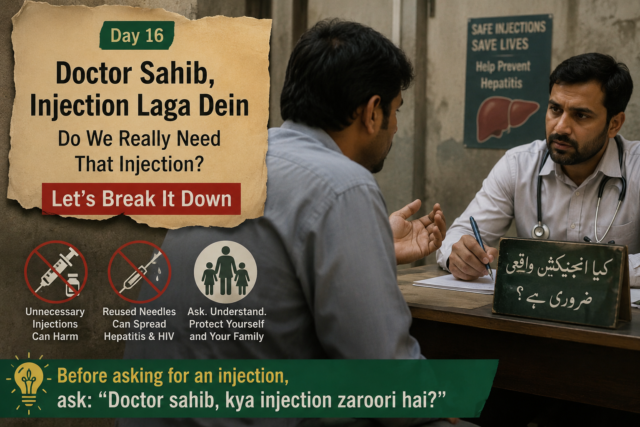
Instead of requesting one, ask:
(Doctor, is an injection really necessary?)
That question allows the healthcare professional to explain the safest and most appropriate treatment.
The message is not that every injection is harmful or unnecessary.
Injections are essential in many situations, including routine immunization, anesthesia, insulin and certain other medicines, emergency treatment, and some serious infections where injectable therapy is medically indicated.
The goal is not to avoid needed treatment.
The goal is to avoid injections given only because they appear stronger or faster.
Parents naturally want quick relief when a baby has a fever, is crying, or appears uncomfortable.
That fear can make an injection seem like the fastest solution.
But an infant or child should not receive an injection simply because the family expects one or because oral medicine has not produced immediate relief.
The treatment should match the child’s medical condition and be decided by a qualified healthcare professional.
Parents can respectfully ask:
“Kya mere bachay ke liye injection zaroori hai, ya munh se di jane wali dawa se ilaaj ho sakta hai?”
(Is an injection necessary for my child, or can the condition be treated with medicine taken by mouth?)
That is not refusing care.
It is participating in safe care.
An injection that is medically necessary and given using new, sterile equipment can be safe.
The danger arises when an unnecessary injection creates an avoidable opportunity for unsafe practice—or when needles, syringes, medication vials, or other equipment become contaminated or are reused.
Unsafe injection practices can transmit bloodborne infections, including hepatitis B, hepatitis C, and HIV.
This does not mean every injection causes hepatitis.
It means every unnecessary injection is an unnecessary procedure—and therefore another avoidable opportunity for something to go wrong.
Unsafe injecting does not occur only in healthcare settings.
Sharing needles, syringes, or other injecting equipment among people who inject drugs can rapidly spread hepatitis B, hepatitis C, and HIV.
This is a difficult subject, especially when young people are involved.
But judgment and silence do not stop infections.
People affected by drug use need prevention, confidential testing, hepatitis B vaccination when appropriate, treatment, substance-use care, and access to evidence-based harm-reduction services.
Judgment does not prevent infection. Early support can.
This topic deserves its own full discussion later in this series.
For patients and families, the first change is simple.
Do not ask for an injection only because you expect faster relief.
Ask:
(Is an injection necessary?)
When medicine by mouth is prescribed, ask how to take it, when improvement may reasonably be expected, what warning signs to watch for, and when to return for medical care.
If an injection is medically needed, make sure new, sterile equipment is used.
Healthcare professionals can also help change this mindset.
A short explanation may change a family’s belief for years:
“You do not need an injection for this condition. The medicine prescribed is appropriate for you.”
Some patients may interpret the absence of an injection as receiving less care.
Explaining why an injection is unnecessary helps people understand that safer care does not always mean more procedures.
The next time someone says:
“Injection lagwa lo. Jaldi araam aa jaye ga.”
(Get an injection. You will feel better quickly.)
Pause and ask:
(Is the injection really necessary?)
If it is necessary, it should be given safely.
If it is not, choosing medicine by mouth or another appropriate treatment does not mean receiving weaker care.
Yesterday, we talked about feeling confident enough to ask whether a syringe is new.
Today, we take one step back and ask whether the injection is needed in the first place.
That small change in thinking can help protect individuals, children, families, and communities—and move Pakistan closer to one goal: a Hepatitis-Free Pakistan.
This article is part of our World Hepatitis Day educational series supporting greater hepatitis awareness and prevention in Pakistan.