info@discoversouls.org
Subscribe to SMS Updates: (850) 308-3944
Supporting 190,000+ Patients Through Pakistan Kidney Institute (PKI)
Understanding how hepatitis spreads is essential because it also helps us understand how to prevent it.
Hepatitis is an inflammation of the liver that can be caused by several viruses. In Pakistan, the two most common types are hepatitis B and hepatitis C. Although they are different viruses, both can lead to chronic liver disease if they are not diagnosed and managed early.
One of the challenges in controlling hepatitis is that many people are infected without realizing it. Because the disease often causes no symptoms in its early stages, people may unknowingly pass the virus to others or seek medical care only after liver damage has already occurred.
For this reason, understanding how hepatitis spreads is an important part of prevention.
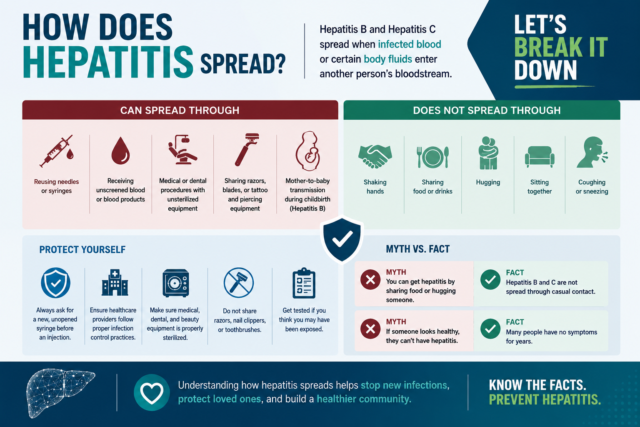
Hepatitis B and hepatitis C spread when infected blood, or in the case of hepatitis B, certain body fluids, enter another person’s bloodstream.
This can happen in several ways, including:
These are well-recognized routes of transmission and highlight why infection prevention practices remain so important in healthcare and community settings.
There are also many misconceptions about hepatitis.
Hepatitis B and hepatitis C are not spread through everyday social contact.
You cannot get hepatitis B or hepatitis C by:
Understanding these facts is important because misinformation can lead to unnecessary fear and stigma toward people living with hepatitis.
The encouraging news is that many hepatitis infections can be prevented.
Simple precautions can make a significant difference, including:
Prevention, early diagnosis, and timely treatment remain the most effective ways to reduce the burden of hepatitis.
You can catch hepatitis by sharing food, hugging someone, or shaking hands.
Hepatitis B and hepatitis C are not spread through casual contact such as hugging, sharing meals, or sitting together.
If I feel healthy, I don’t need to think about hepatitis.
Many people with hepatitis have no symptoms for years. Early testing is often the only way to detect the infection before serious liver damage develops.
Reducing hepatitis is about more than treating disease after it occurs. It is also about preventing new infections before they happen.
Understanding how hepatitis spreads helps individuals make informed decisions, supports safer healthcare practices, reduces stigma, and encourages early testing.
Every person who understands these facts has the opportunity to help protect not only themselves, but also their family and community.
This year’s World Hepatitis Day theme, “Let’s Break It Down,” reminds us that public health information should be easy to understand.
Every question we answer helps replace myths with facts. Every conversation about hepatitis helps build greater awareness. And every step toward prevention brings us closer to reducing the burden of hepatitis in Pakistan and around the world.
This educational series is inspired by Prof. Dr. Saeed Akhtar’s long-standing vision for hepatitis elimination in Pakistan. Drawing on guidance from the World Health Organization (WHO) and other trusted public health resources, each article explains one topic at a time in clear, practical language. Our goal is to support greater awareness, encourage early testing, promote prevention, and contribute to the shared vision of a Hepatitis-Free Pakistan.