
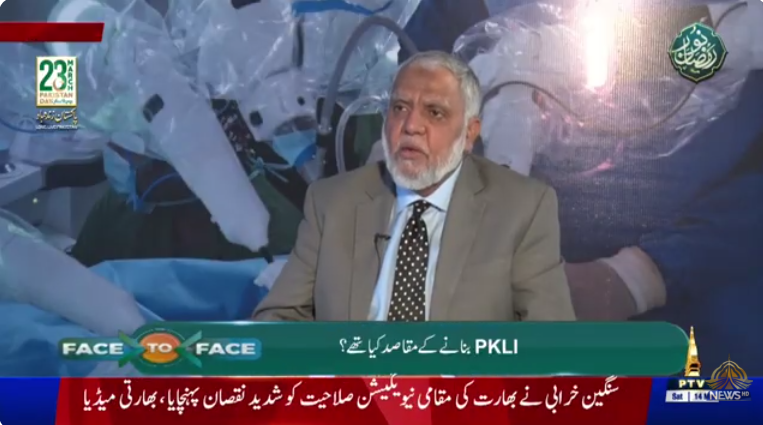
A National Conversation on Healthcare
In a recent episode of Face to Face on Pakistan Television Corporation (PTV), hosted by Komal Saleem, the discussion began with a public health concern that many families in Pakistan already recognize:
- Kidney and liver diseases are rising
- The pressure on hospitals continues to grow
The causes, as highlighted, are not abstract:
- Poor diet
- Dietary negligence
- Preventable diseases
- The burden of a growing population
Leadership with a System-Based Vision
The guest was Prof. Dr. Saeed Akhter — President, Pakistan Kidney Institute (PKI); Chairman, Pakistan Kidney and Liver Institute (PKLI); Chairman, Jinnah Medical Complex & Research Center (JMC & RC); and Member, Prime Minister’s Task Force for Hepatitis C Elimination.
He spoke not only as a senior surgeon and institutional leader, but as someone focused on building a long-term healthcare model.
In the interview, he described PKLI as:
- More than a hospital
- A system built on high-end care, research, education, and fairness
The Journey of PKLI
Prof. Dr. Saeed explained that:
- PKLI was established in 2017
- It is now approximately a seven-year-old institution
However, the journey was not without challenges:
- Early institutional setbacks
- The impact of the COVID-19 pandemic
According to him:
- The institute’s real momentum began after 2020
- It has now reached its “first milestone”
This milestone represents:
- Stability in systems
- Functional clinical services
- A foundation for long-term growth
Clinical Excellence and Scale
PKLI has developed into a comprehensive tertiary care institution offering:
- Kidney and liver transplantation
- Robotic surgery
- Cancer surgeries (liver, kidney, bladder)
- Interventional radiology
- Dialysis
- Gastroenterology
Its impact is reflected in key achievements:
- Approximately 5 million patient encounters
- Around 1,200 kidney transplants
- Around 1,000 liver transplants
- More than 500 robotic surgeries
In addition:
- Around 500 transplants were performed last year
- The expectation for the current year is 500 to 600 transplants
A System Built by People
Prof. Dr. Saeed emphasized that PKLI’s success is not attributed to a single individual.
He acknowledged the contribution of:
- Government support
- Institutional leadership
- Entire operational teams, including:
- Doctors and surgeons
- Nurses and paramedics
- Administrative staff
- Support staff, including guards and housekeeping
His message was clear:
- Institutions are built through collective effort
- Systems succeed when people work within a shared mission and structure
Robotic Surgery: Advancing with Purpose
A key focus of the discussion was PKLI’s adoption of robotic surgery.
Prof. Dr. Saeed explained that:
- Leading countries — including China, India, the United States, and the United Kingdom — have already advanced in this field
- PKLI could not afford to remain behind
He highlighted major achievements:
- Successful robotic Whipple procedure for pancreatic cancer
- Pakistan’s first robotic liver cancer surgery
He clarified an important point:
- Robotic surgery does not replace the surgeon
- It enhances surgical capability through advanced tools
Key benefits include:
- Smaller incisions
- Greater precision
- Improved visualization
- Shorter hospital stays
- Faster recovery and return to daily life
Regarding cost:
- The robotic system is valued at approximately $2 million
- PKLI adopted a strategic model where:
- The company provides the machine
- The institute primarily manages the cost of consumables
This approach reduces financial burden while maintaining access to advanced technology.
A System Built on Equity
For Prof. Dr. Saeed Akhter, the real strength of PKLI is not technology — it is equity in patient care.
PKLI operates on a structured and transparent financial model designed to ensure access for all patients:
- 80% of patients receive subsidized treatment
- Within this group:
- 50% receive completely free care
- 30% are partially subsidized
- Among them, nearly 90% pay only 5% to 10% of the total treatment cost
- Only about 20% of patients are full-paying
Equal Care for Every Patient
A key principle of the system is fairness in treatment:
- Surgeons are not informed about a patient’s financial status
- This ensures that every patient receives the same quality of care, regardless of their ability to pay
A Founding Principle
At its core, PKLI was built on a clear and powerful vision:
No patient should lose their life simply because they cannot afford treatment.
From Treatment to Vision
Prof. Dr. Saeed Akhter emphasized that PKLI was never intended to function as just a treatment center.
His vision is far broader — to build what he described as a “Harvard of the East,” rooted in three core pillars:
- High-quality surgical care
- Medical education
- Research
As part of this vision:
- PKLI is currently training around 100 young doctors and specialists
- This educational role is critical, as Pakistan will require many more institutions like PKLI in the future
Research as a National Priority
According to Prof. Dr. Saeed, research is not an academic luxury — it is a national necessity.
- PKLI has allocated approximately 1 billion rupees for research
- This includes the development of a biobank and advanced research infrastructure
- The goal is not limited to publishing papers, but to build economically viable and self-sustaining research
He projected that:
- Within five years, this investment could generate up to 10 billion rupees
- PKLI could attract international clinical trials, based on its systems, transparency, and credibility
Why Local Research Matters
Prof. Dr. Saeed highlighted a critical gap:
- Medical research cannot be fully imported
- Diseases behave differently across populations due to:
- Genetics
- Diet and lifestyle
- Environmental factors
He cautioned against Pakistan remaining a consumer-only system, dependent on:
- Imported medicines
- Foreign research
- External treatment protocols
Instead, he emphasized the need to build:
- Local medicines
- Local discoveries
- Local clinical protocols
- Locally relevant medical evidence
He also pointed to Pakistan’s rich herbal and botanical resources as an underexplored area that deserves serious scientific research.
The institutional story he told also included politics, but in a very specific way. He credited Shahbaz Sharif, then Chief Minister of Punjab, with providing strong support during PKLI’s development. But he said that support only worked because two conditions were agreed upon from the beginning: no political interference and no bureaucratic interference. In his account, this freedom allowed professional judgment, merit, and systems to function without distortion. He tied this directly to PKLI’s development and to the confidence the institution now projects.
That confidence, he argued, is now visible internationally. He referred to PKLI’s first international symposium, where doctors from the UK, USA, Singapore, and Europe attended along with leading Pakistani specialists. According to him, many visitors were struck by what had been built in such a short time. He also mentioned PKLI’s JCI accreditation, explaining that the institute built its systems around Joint Commission International principles and formally invited JCI to inspect them in 2024. He said PKLI is the first JCI-accredited public-sector institution in Pakistan, and that this matters because it is not merely the institute praising itself — it is an international body validating its systems and standards.
Prevention: The Most Critical Public Health Priority
The second half of the interview shifted toward prevention — one of the most important and impactful parts of the discussion.
Prof. Dr. Saeed Akhter highlighted that:
- Approximately 80% of liver disease in Pakistan is caused by Hepatitis B and C
- Hepatitis B is preventable through vaccination
- Hepatitis C is curable if diagnosed and treated early
He emphasized that Pakistan carries one of the highest burdens of Hepatitis C, and many individuals remain unaware of their infection for years — often until their liver has already suffered significant damage over time.
He described this as a critical opportunity:
- Early detection and treatment can prevent progression to liver failure
- Timely intervention can save lives and reduce long-term healthcare burden
Early Detection Through Community-Based Care
PKLI is addressing this challenge through:
- 18 filter clinics across Punjab
- Focus on screening, early diagnosis, vaccination, and treatment
These clinics serve as the first point of contact, helping identify disease before it reaches advanced stages.
Kidney Disease: Preventable but Often Missed
Prof. Dr. Saeed also highlighted the preventable nature of kidney disease:
- Major causes include:
- Uncontrolled blood pressure
- Uncontrolled diabetes
- Approximately one-third to one-fourth of the population is diabetic, increasing the risk of kidney failure
He stressed that early diagnosis can significantly reduce the need for dialysis or transplant.
Simple screening methods can detect early signs:
- Urine dipstick tests can identify:
- Protein
- Glucose
- Blood
Each of these findings can point toward underlying, treatable conditions.
Vaccination, Hygiene, and Public Awareness
A major concern raised was public behavior around prevention:
- Many individuals seek care only after symptoms appear
- Preventive measures such as vaccination are often overlooked
Prof. Dr. Saeed emphasized:
- The importance of Hepatitis B birth-dose vaccination, which costs only around five cents
- The need for widespread public education
He also highlighted common transmission risks that continue due to lack of awareness:
- Use of unsterilized syringes
- Reused barber blades
- Contaminated tools in beauty parlors and tattooing
- Poor sterilization in medical and dental settings
These are not isolated issues, but everyday practices that contribute to disease spread.
Lifestyle: The Root Cause
The discussion also addressed lifestyle as a major driver of disease:
- Diabetes and hypertension remain leading causes of kidney failure
- Poor dietary habits continue to increase disease burden
Prof. Dr. Saeed simplified the issue in clear terms:
- Excess sugar
- Excess salt
- Lack of physical activity
He referred to sugar and salt as the “two white poisons.”
He also highlighted that:
- Fatty liver disease is increasingly linked to excessive sugar intake and metabolic imbalance
- It is now the third most common cause of liver transplant in Pakistan, after Hepatitis B and C
The Need for Cultural Change
Prof. Dr. Saeed emphasized that prevention must go beyond hospitals:
- It should become part of public awareness campaigns
- It should be integrated into education systems and school curriculum
Without this shift, the healthcare burden will continue to rise despite advancements in treatment.
Organ Donation: A Critical Gap
Another major focus of the discussion was organ donation.
Prof. Dr. Saeed Akhter highlighted that while Pakistanis are known for their generosity, the country continues to lag behind in deceased donor transplantation.
- In Pakistan, most transplants rely on living family donors
- In many Western countries, nearly 50% of transplants come from brain-dead donors
He emphasized the life-saving potential of organ donation:
- A single deceased donor can help save up to 11 lives
- Organs and tissues that can be donated include:
- Corneas
- Liver
- Kidneys
- Pancreas
- Heart
- Lungs
Breaking Misconceptions
Prof. Dr. Saeed made it clear that:
- Religion is not the primary barrier to organ donation
- The real challenges are:
- Social attitudes
- Lack of awareness
- Public misconceptions
He emphasized the important role of media and public education in reshaping understanding and encouraging ethical organ donation.
Addressing Illegal Practices
The discussion also addressed the darker history of transplantation in Pakistan.
- At one time, Pakistan became known as a hub for organ selling
- Although unethical, such practices were not formally illegal until legal reforms in 2010
Prof. Dr. Saeed strongly condemned illegal transplantation and warned patients against:
- Falling into the hands of individuals making false promises
- Engaging with systems driven by financial exploitation
He stated clearly that such individuals should not be considered medical professionals, but rather traders operating outside ethical boundaries.
Ethical and Legal Alternatives
Despite these challenges, he highlighted that ethical solutions do exist:
- Deceased donor transplantation
- ABO-incompatible exchange donation, where:
- Donor-recipient pairs who are not compatible can exchange donors
- Transplants can still be performed safely and legally
These approaches offer pathways to expand transplantation while maintaining ethical and medical standards.
Scale of Operations: A Growing Healthcare System
The interview also highlighted the operational scale of PKLI, reflecting its expanding role in Pakistan’s healthcare system.
- Approximately 2,000 outpatients are seen daily at PKLI
- The network of 18 filter clinics across Punjab manages a significant additional daily patient load
- Overall, around 34,000 patients are being served across the wider system
Hospital capacity further reflects this scale:
- Around 350 inpatient beds
- Approximately 480 total beds
- Around 65 ICU beds
Due to the complexity of procedures performed:
- Nearly 50% of post-surgical patients may require ICU or ventilator support
Expansion and Future Infrastructure
Expansion remains a key priority in meeting growing healthcare demands.
- PKLI has initiated development in Rawalpindi, with a current capacity of approximately 125 beds
- Plans are in place to begin transplant services, with further expansion projected
Future development includes:
- Expansion of the Rawalpindi facility to 400–500 beds
- A broader vision to establish more than 100 PKLI-type institutions across Pakistan
Looking ahead, Prof. Dr. Saeed also outlined plans for:
- A dedicated Heart and Lung Institute
- Development on approximately 60 acres adjacent to the Lahore campus
- Future capability for heart and lung transplantation
A Message to the Public
In closing, Prof. Dr. Saeed Akhter delivered a clear and meaningful message.
- Health is one of Allah’s greatest blessings
- It must be protected through:
- Prevention
- Healthy lifestyle choices
- Regular exercise
- Early diagnosis
He also emphasized the importance of public support:
- Encouraging people to view PKLI as their own institution
- Supporting it through charity and zakat, particularly during Ramadan
- Ensuring confidence that contributions are used transparently for patient care
Importantly, he clarified that PKLI does not operate in competition with other institutions.
- Its goal is to strengthen the overall healthcare system in Pakistan
- This includes sharing knowledge, building capacity, and supporting broader healthcare development
Source and Credit
This article is based on the PTV program Face to Face, hosted by Komal Saleem, featuring Prof. Dr. Saeed Akhter. It is written in English to make the discussion accessible to readers who could not follow the original Urdu broadcast.
