
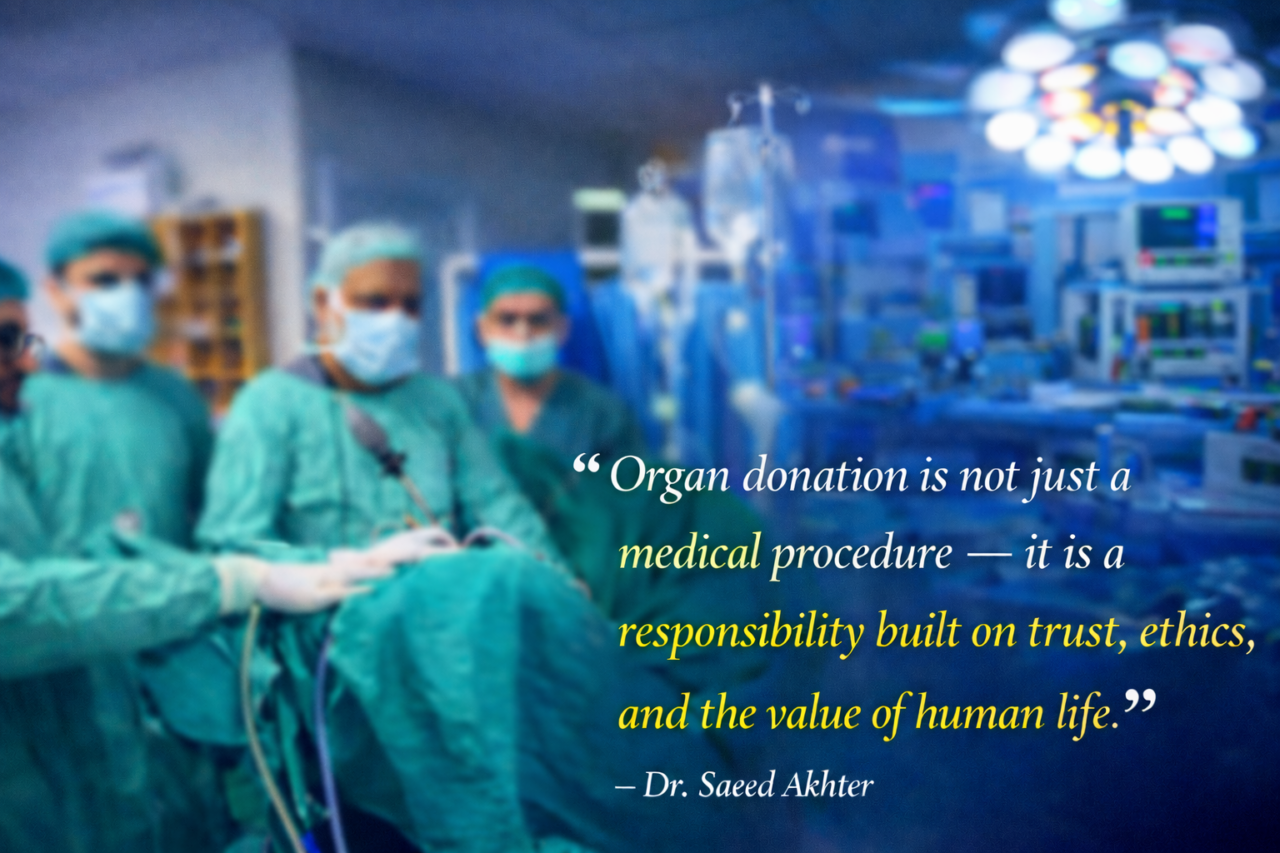
April is observed in the United States as National Donate Life Month, a time dedicated to raising awareness about organ, eye, and tissue donation. This year’s theme, “Leave a Legacy,” asks a simple but powerful question: what do we leave behind?
For me, that question is deeply personal.
As a living kidney donor, I do not see organ donation as a slogan or a statistic. I see it as a choice that gives another person a chance to live with dignity, hope, and freedom from the burden of waiting. It is one of the most meaningful acts of compassion a person can make.
I donated a kidney to my sister. She is healthy now — working, living fully, enjoying her life in ways she could not before. And I am fine. Healthier in some ways, honestly. I drink more water now, which I probably would never have taken seriously otherwise. Small thing, but it is mine.
It was through Discover SOULS and Dr. Saeed Akhtar’s work that I came to understand donation as something bigger than one family’s story. I am not sharing this to make it about me. I share it because in Pakistan, I have seen how little people know about donation — and how much that lack of knowledge costs.
The Need Is Urgent
While April is recognized in the United States, the need for organ donation reaches far beyond one month or one country. If April brings this conversation forward in one part of the world, in Pakistan it is a conversation that cannot wait.
In Pakistan, the numbers are difficult to sit with. According to Pakistan Kidney and Liver Institute, the country needs an estimated 2,000 lung transplants, 7,000 heart transplants, close to 100,000 liver transplants, and about 25,000 kidney transplants every year. Behind each of those numbers is a person. A family. A life that has been put on hold.
Hope Is Already Happening
That change is not distant. In Pakistan, institutions like Pakistan Kidney Institute and Pakistan Kidney and Liver Institute & Research Centre are already doing this work — performing kidney and liver transplants and slowly building a culture where donation is understood and accepted.
These are not just surgical centers. They are places where some of the hardest family conversations happen. Where donors are evaluated carefully. Where medical teams carry enormous responsibility with very little public recognition. And where care does not stop after surgery — it continues through follow-up, patient education, and long-term support.
Dr. Saeed Akhtar’s Contribution
This is where Dr. Saeed Akhtar’s work over many decades becomes especially relevant.
He has been one of the most consistent voices in Pakistan pushing for organ donation practices that are ethical, legal, and transparent. He has opposed the illegal organ trade and worked toward a centralized system that protects both donors and recipients. He helped lay the groundwork for institutions where ethical transplantation could actually take root — places where patients are treated with dignity and donors are never exploited.
He has also been direct about something many avoid saying — that deceased donation in Pakistan remains far too limited, and that closing that gap requires public trust as much as it requires medical infrastructure.
His focus has never been surgery alone. It has been about whether people believe the system is honest enough to trust. Without that belief, no amount of medical capability is enough.
Why People Hesitate
In Pakistan, I have seen families who have never had a single conversation about organ donation — not because they don’t care, but because no one explained it to them. The process feels complicated. The information is not there. And the fear that donation will harm the donor is widespread.
That fear kept me from dismissing people who have it. I understand where it comes from. But I can say from experience: I take no medications. I am an active, healthy woman. If anything, the donation made me more conscious of my health, not less.
Dr. Saeed Akhtar has long stressed that healthcare professionals and religious scholars play a critical role here — correcting misconceptions and building trust. Because in most families, a decision about donation is never made alone. It is discussed, weighed, and felt by everyone.
This is why awareness cannot wait for a crisis to force the conversation.
From Awareness to Responsibility
Still, no system — however well built — can function without donors.
Trained surgeons can be ready. Hospitals can be equipped. Patients can be waiting. But if no one comes forward, none of it moves. That gap between what exists and what is needed is filled only by awareness, by honest conversation, and by people willing to ask questions they have been putting off.
This responsibility does not belong to one country or one month. It belongs in homes, in clinics, in mosques and churches, and in the kind of quiet conversations that happen before a crisis makes them urgent.
What Leaving a Legacy Means
Legacy is not about recognition. It is about what continues after you.
For some people that is work they built. For others it is how they raised their children or served their community. For a donor, it can be something even more direct — another person’s life.
Dr. Saeed Akhtar has spent decades building that kind of legacy — not through a single act but through consistent, unglamorous work that has made transplantation safer, fairer, and more available to people who need it most.
I donated a kidney. My sister got her life back. I do not need it to be more complicated than that.
— Naima Khan
Executive Director, Discover SOULS
Living Kidney Donor & Advocate
