
There are moments when you listen to global health experts and realize that what they are saying is not just information—it is a warning.
In discussions led by Prof. Olufunmilayo (‘Funmi) Lesi message comes through clearly:
Viral hepatitis remains one of the most serious and overlooked public health challenges in the world today.
And within that global picture, Pakistan stands at a critical point.
Understanding WHO and Why Pakistan Matters
The World Health Organization is the global body that works with countries to track diseases, guide public health strategies, and support efforts to prevent and treat major health threats.
When WHO highlights a country, it is not random.
It is because the scale of the issue demands attention.
Pakistan is one of those countries.
🇵🇰 Why Pakistan Has One of the Highest Hepatitis C Burdens
In Pakistan today, Hepatitis C is not rare it is widespread.
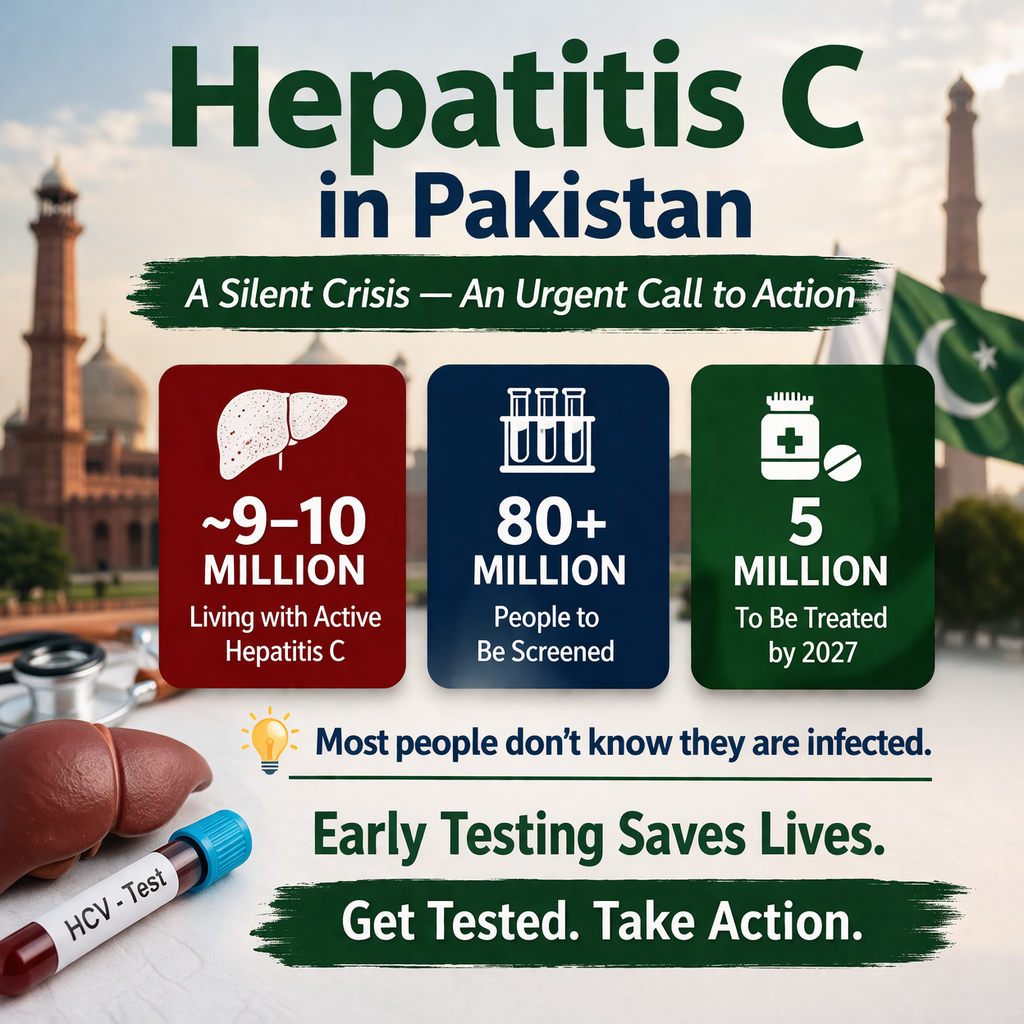
Millions of people are living with the virus. Many do not know they have it.
This has happened over time due to a combination of factors:
- Unsafe medical and injection practices
- Reuse of syringes and poor sterilization in some settings
- Limited awareness about how the disease spreads
- Late diagnosis, often after serious liver damage
- Social stigma that prevents people from getting tested
What makes Hepatitis C even more dangerous is that it often remains silent for years.
A person may feel completely normal while the disease slowly damages the liver.
📊 The Scale of the Problem
Pakistan is considered among the countries with the highest Hepatitis C burden globally.
This is why global leaders like Prof.Olufunmilayo Lesi continue to emphasize urgent action.
Because without intervention, the numbers will continue to grow and so will the consequences.
A National Response: Pakistan’s Hepatitis C Elimination Program
Pakistan has taken a major step forward with the launch of:
The Prime Minister’s National Programme for the Elimination of Hepatitis C Infection
This program aims to:
- Test over 80 million people
- Treat 5 million individuals by 2027
- Work toward eliminating Hepatitis C by 2030
This is one of the largest public health initiatives ever undertaken in the country.
What Success Could Mean
If this program is implemented effectively, the impact could be transformative:
- Thousands of lives saved
- Significant reduction in liver failure and liver cancer
- Millions of people cured through treatment
- Reduced long-term healthcare burden
- Stronger public health infrastructure
This is not just about treating a disease.
It is about changing the future of public health in Pakistan.
The Real Challenges Ahead
While the plan is strong, the challenges are real.
1. Many People Are Still Undiagnosed
Testing remains one of the biggest gaps.
2. Patients Drop Out of Care
From screening to treatment, many do not complete the journey.
3. Trust Needs to Be Built
People hesitate due to fear, misinformation, or past experiences.
4. Awareness Is Still Limited
Many people still do not know that Hepatitis C is treatable.
Without addressing these challenges, even the strongest programs cannot succeed.
Why Awareness Matters More Than Ever
From community interactions and real patient experiences, one thing becomes clear:
People do not act on statistics they act on understanding.
When awareness is clear and relatable:
- People come forward for testing
- Families support each other
- Communities begin to talk openly
Without awareness, silence continues—and so does the disease.
A Shared Responsibility
Eliminating Hepatitis C is not only the responsibility of:
- Government
- Doctors
- Health institutions
It requires participation from everyone.
- Individuals must get tested
- Families must encourage awareness
- Communities must reduce stigma
Because public health only works when people are part of it.
What Happens If We Do Nothing?
If Hepatitis C is not controlled:
- Liver disease and cancer cases will rise
- Healthcare costs will increase
- Families will face long-term emotional and financial stress
And the most difficult reality is this:
Much of this suffering is preventable.
Final Thought
Pakistan has taken a critical step forward.
Global organizations are supporting the effort.
The tools to eliminate Hepatitis C already exist.
But elimination will not happen through policy alone.
It will happen when people take action,when testing becomes normal, when awareness replaces fear, and when communities begin to engage.
The opportunity is here.
What happens next depends on all of us.
- WHO Global Hepatitis Team Lead – Prof. Olufunmilayo (‘Funmi) Lesi
- WHO Pakistan (Hepatitis Updates): World Health Organization
