
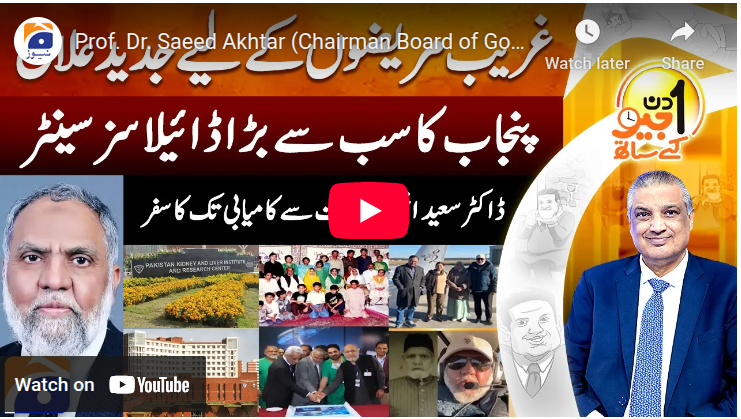
In a widely viewed interview on Geo News’ well-known program Aik Din Geo Ke Sath, senior journalist Sohail Warraich spent time with Prof. Dr. Saeed Akhtar — President of the Pakistan Kidney Institute (PKI), Chairman of the Pakistan Kidney and Liver Institute and Research Center (PKLI), Chairman of Jinnah Medical Complex and Research Center (JMC), and Member of the Prime Minister’s Task Force for Hepatitis C Elimination.
The program is known for taking viewers inside the workplaces and lives of influential personalities, allowing audiences to understand their journeys not only through conversation but also through visits to their institutions, meetings with colleagues, and discussions with family members. During this interview, Prof. Dr. Saeed Akhtar spoke openly about his upbringing, his academic journey, the experiences that shaped his worldview, and the vision that led to the establishment of one of Pakistan’s most ambitious healthcare institutions.
The conversation offered a rare opportunity to see the personal story behind PKLI — a story that combines humble beginnings, international success, spiritual reflection, and a long-term commitment to building institutions for the country.
Early life in Khanewal
Prof. Dr. Saeed Akhtar grew up in Khanewal, where his father served in the Town Committee. The family lived what he described as a modest middle-class life. Material resources were limited, yet he remembers the atmosphere of his childhood as one of contentment rather than hardship.
He recalled that sometimes there might have been only one pair of shoes, but the family did not constantly feel deprived. Instead, there was a sense of gratitude and satisfaction that shaped his outlook from an early age.
The household also had a strong literary and intellectual environment. His father wrote poetry, and his elder sister also had a deep interest in poetry. Literature, conversation, and cultural expression were natural parts of daily life.
His brothers played important roles in shaping his educational path. One brother had a strong passion for learning, while another, who served in the Air Force, took him to Karachi, where he continued his studies and moved closer to a career in medicine.
Education and academic achievement
From an early age, Prof. Dr. Saeed Akhtar aspired to become not only a doctor but a highly accomplished one. His dedication to education led him to Sindh Medical College, where he pursued medical training with distinction.
He later achieved top position at Karachi University, an accomplishment that opened the door to a scholarship opportunity. That scholarship ultimately led him to the United States, where he would encounter academic environments that deeply influenced his thinking.
The intellectual influence of Yale and Harvard
One of the most important phases of his academic journey took place at Yale University. He described Yale as an environment where research and intellectual curiosity shaped everyday life. Scientists and scholars were constantly discussing topics such as DNA, RNA, vaccines, and new discoveries in medicine.
He recalled interacting with Nobel laureates, observing their work, and witnessing a culture that emphasized serious intellectual effort rather than outward display. Small offices filled with books, intense discussions about research, and a focus on discovery left a lasting impression on him.
It was during his time at Yale that a crucial idea began forming in his mind: if institutions like this could exist elsewhere in the world, then Pakistan should also be able to build institutions of similar quality.
He later spent time at Harvard University as a research fellow, where he studied not only medical science but also how institutions grow over time. Observing universities that had evolved over centuries helped him understand that strong institutions require patience, vision, and long-term commitment.
Professional success in the United States
In the United States, Prof. Dr. Saeed Akhtar established a successful career as a urologist. He spoke candidly during the interview about the financial opportunities available in such specialties. Physicians in his field, he noted, could earn between one and two million dollars annually.
His wife, Dr. Masooma, is an anesthesiologist — another highly respected medical profession. Together they built a successful professional life abroad and enjoyed financial stability and comfort.
He acknowledged that during this period he had access to many of the symbols of success — comfortable homes, expensive cars, and even aircraft. Yet as he later reflected, there comes a point in life when a person begins to question the deeper meaning of success and the reality of life beyond material achievements.
A spiritual turning point
One of the most significant moments in his story occurred during his years in Texas, when he lived near Cannon Air Force Base during the Gulf War period.
At the time, he encountered American soldiers who had accepted Islam and began attending the local mosque. Curious about their journey, he asked them why they had embraced the faith.
Their answer was simple: they had read the Qur’an.
This response prompted him to reflect deeply on his own understanding of Islam. He described this period as a form of spiritual renewal — almost as if he rediscovered his faith with fresh awareness.
This experience gradually reshaped his priorities. The material success he had achieved in the United States no longer felt like the ultimate purpose of life. Instead, he began thinking about how his skills and experiences could contribute to something larger.
Returning to Pakistan with a vision
By the time he returned to Pakistan, the idea of building a major medical institution had already begun to take shape.
He believed that Pakistan needed institutions that could combine world-class medical standards, research, education, and patient care.
After returning home, he worked in established hospitals and observed that while high-quality care existed, it was often accessible primarily to those who could afford it. This realization strengthened his determination to build a system where medical care would be accessible regardless of financial status.
He summarized the vision behind his work with two fundamental principles.
First, to build a healthcare institution that could meet international standards of excellence.
Second, to ensure that no poor patient would be denied treatment simply because they lacked financial resources.
Equal dignity in healthcare
Before the establishment of PKLI, Prof. Dr. Saeed Akhtar helped build an earlier model under which large numbers of patients received treatment free of cost. Approximately 200,000 patients were treated through this system.
However, the most important principle was not simply providing free treatment. The central idea was that the quality of care must remain identical for both rich and poor patients.
Once a patient entered the healthcare system, he explained, no one should be able to identify whether that patient was wealthy or financially struggling. Every individual should receive treatment with equal dignity and the same medical standards.
The creation of PKLI
This vision eventually led to the establishment of the Pakistan Kidney and Liver Institute and Research Center (PKLI).
When the project began, Prof. Dr. Saeed Akhtar served as both Chairman and CEO during its formative phase. Although the board had approved a salary for him, he chose not to take any salary for four years, emphasizing that the institution was a mission rather than a personal career opportunity.
The institute was built with the goal of meeting global healthcare standards while serving patients from all economic backgrounds.
Growth and achievements
Over time, PKLI developed into one of the most advanced medical centers in Pakistan.
According to figures shared in the interview, the institution has treated more than 1.8 million patients.
Medical achievements include approximately:
-
1,000 liver transplants
-
1,200 kidney transplants
-
7,000 urological surgeries
-
5,000 interventional radiology procedures
-
hundreds of robotic surgeries
The institute has also achieved strong survival outcomes, with liver transplant survival rates around 90 percent and kidney transplant outcomes approaching 97 percent, comparable to leading centers internationally.
Systems, standards, and patient safety
Prof. Dr. Saeed Akhtar emphasized that successful healthcare institutions depend on strong systems rather than individual efforts alone.
A patient’s journey through a hospital involves hundreds of steps, from registration and diagnosis to treatment and recovery. Each step requires clearly defined procedures to ensure safety and accuracy.
PKLI therefore invested significant effort in preparing for international accreditation standards that measure patient safety, treatment outcomes, and healthcare quality.
These benchmarks allow institutions to compare their performance with global standards.
A broader healthcare ecosystem
PKLI today represents more than a single hospital. It includes multiple services, educational institutions, and healthcare networks.
The Institute of Nursing and Allied Health Sciences trains healthcare professionals through undergraduate programs and internship structures designed to strengthen Pakistan’s medical workforce.
PKLI also operates dialysis facilities that rank among the largest in Punjab.
Infrastructure investments include advanced diagnostic equipment such as PET scans, modern surgical technology, dedicated power grid systems, backup generators that activate within seconds, and large solar installations to reduce operational costs.
Institutional culture
The institute has also developed a culture of internal dialogue through town hall meetings, where staff members from different levels participate in discussions about institutional progress and share their perspectives.
International recognition
A major milestone highlighted during the interview was an international medical symposium PKLI International Symposium hosted by PKLI.
Doctors and specialists from many countries attended the event. According to Prof. Dr. Saeed Akhtar, several visiting physicians expressed surprise at the level of medical work being conducted in Pakistan.
For him, the symposium represented an important step in introducing a Pakistani institution to the global medical community.
Bringing overseas doctors back
Another important goal has been encouraging Pakistani physicians working abroad to return home.
Prof. Dr. Saeed Akhtar personally traveled to the United States, the United Kingdom, and the Middle East to invite doctors to participate in building the institution.
Around 150 doctors expressed interest, and approximately 30 initially joined the effort. However, institutional controversies later caused 17 of them to return abroad.
He believes that the long-term return of global talent will depend on the strength and stability of institutions within Pakistan.
Family life and support
During the interview, viewers also met Dr. Masooma, his wife and professional partner in medicine.
The couple married in 1988 and built their careers together while raising two children. Both of their children later pursued medical careers in the United States. Their son is a pulmonary critical care specialist, and their daughter is a gastroenterologist.
Prof. Dr. Saeed Akhtar openly acknowledged that the support of his wife played a crucial role in the long journey of building PKLI.
Personal trials
The path of building a national institution has not been free of challenges. The institute faced controversy and legal scrutiny during certain periods.
Prof. Dr. Saeed Akhtar described one of the happiest moments of his life as the day a Supreme Court bench cleared him of allegations and reinstated him, allowing him to continue his work.
Personal inspirations
When asked about the most painful moment of his life, he spoke about the death of his mother, to whom he was deeply attached.
Beyond medicine, he maintains a strong appreciation for literature and poetry. He particularly admires the work of Allama Iqbal, whose poetry he believes contains profound philosophical depth.
He also mentioned writers such as Hali, Shafiq-ur-Rehman, and Ibn-e-Insha, reflecting the literary environment that shaped his childhood.
Looking toward the future
PKLI continues to expand its long-term vision.
Future goals include strengthening transplant programs and eventually developing broader transplant services such as lung and heart transplants. Another important area is increasing public awareness about organ donation after brain death, which remains an evolving concept in Pakistan.
Prof. Dr. Saeed Akhtar believes that meaningful national progress depends on building strong institutions capable of sustaining medical research, education, and healthcare services.
For him, the work of building institutions is a long journey that requires patience and dedication.
Credit / attribution line:This article is based on insights shared during Prof. Dr. Saeed Akhtar’s appearance on the Geo News program Aik Din Geo Ke Sath, aired on March 8, 2026. Readers are encouraged to watch the original Geo News program for the full Urdu interview.
